
Israelis have been using dark humor to cope with tragedy since October 7th. Now, there has been a notable increase in dark humor on social media since the war escalated to include Iran.
Sophomore Gilad Gefen said, “I don’t mind people using dark humor when talking about the war. It’s something that I do and others do all the time.”
Using humor and laughing has been proven to help alleviate trauma and stress. Laughter “stimulates many organs, rapidly activates and relieves your stress response and soothes tension,” according to Mayo Clinic.
The most popular outlets for dark humor, especially among Gen Z and Millennials, are TikTok and X. These social media platforms have thousands of dark humor posts about the war.
One tiktok post showed missiles exploding in the sky with the song “Starships” by Nicki Minaj playing in the background, while another post depicted a Jew and Arab dancing together, with the caption “Israel and Iran after 14 year old Emily posted ‘Stop the war🇮🇷🇮🇱🕊️’ on her story.”
Internet and TV dark humor are centered around the same topics, however, a lot of Internet dark humor uses AI to create memes.
In 2024, an Israeli netizen used AI to generate an image of mullahs riding missiles on magic carpets. Though many take offense to that image, it shows how dark humor is growing in the mainstream.
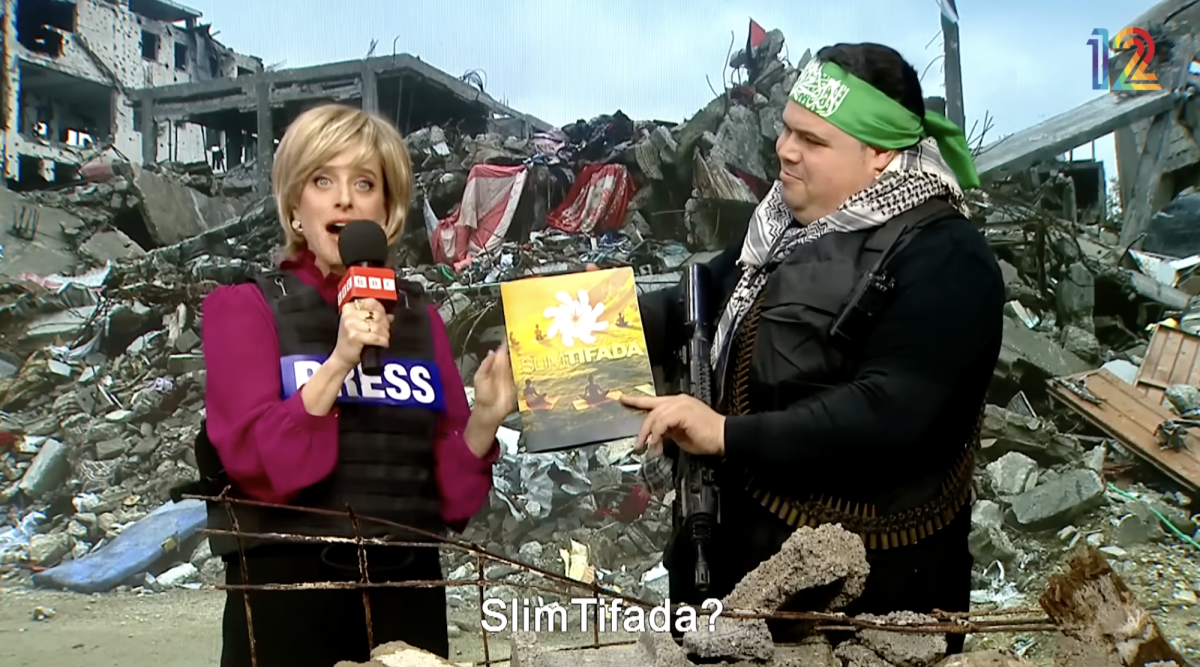
Another popular source of dark humor is Eretz Nehederet (ארץ נהדרת), an Israeli comedy show often dubbed “Israeli SNL.” Eretz Nehderet has been on the air since 2003 broadcasting comedy sketches.
Since the beginning of the war, Eretz Nehederet has performed sketches poking fun at Israeli and Iranian leaders, as well as Hamas.
GOA Hebrew teacher Morah Cudkevich said, “I love Eretz Nehederet, I have it on every Wednesday night, however, there are many times where it turns from funny to offensive.”
The sketch “Slimtifada,” was particularly controversial, making jokes out of how hostages were starved to emaciation.
While coping with humor has its benefits, clearly it comes with considerable risks as well.
People using dark humor in a serious situation risk being taken literally and offending others, especially those who have been directly impacted by the war, or elderly who don’t understand modern humor.
“These memes come up on my grandma’s facebook feed all the time, and it frustrates her that people are joking about something that has killed thousands,” said freshman Tamar Ashkenazi.
The rise in dark humor is not a random occurrence, but a custom rooted in human psychology. Humor acts as a natural coping mechanism.
Dark humor and satire have been deeply engraved in Israeli culture since the War of Independence.
Dizgan and Schumacher were a Polish-Jewish comedy duo who moved to Israel after the Second World War that made skits criticizing the German and Polish government.
They also performed for soldiers in the Six-Day War, but unfortunately the soldiers didn’t find their performance amusing.
Dark humor allows others to build an outlet for themselves and find a community in a time or place where that is not an easy task.
Humor is a form of resilience in trivial times and is many people’s strongest defense. It shapes the narrative and influences generations, for now and the future.