
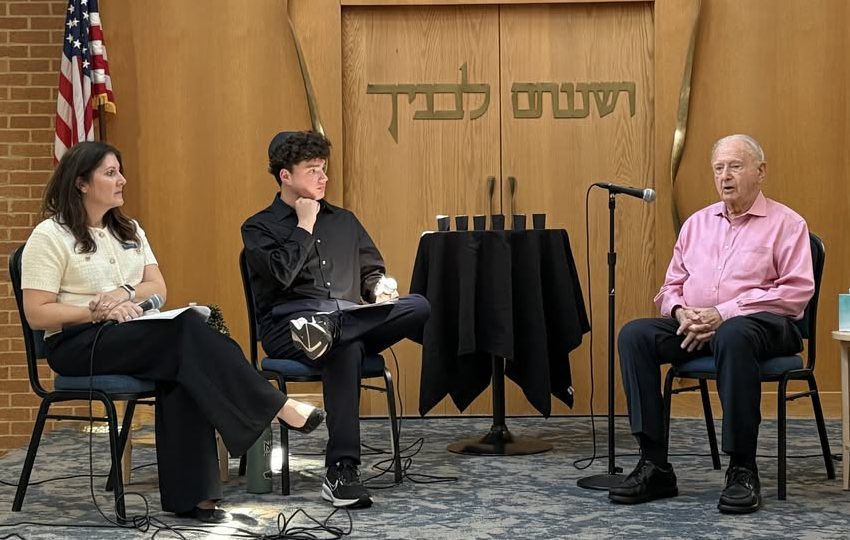
Holocaust survivor Norbert Strauss shared his survival story with students and faculty as part of GOA’s Sala Elbaum Yom HaShoah Program.
“Planning the Yom HaShoah program was centered on securing a meaningful speaker. As many organizations, synagogues and schools seek to include a Holocaust survivor’s testimony on this day, finding someone available can be challenging,” said Mrs. Sternthal, GOA’s Holocaust Education Coordinator.
“We were incredibly fortunate that Mr. Strauss was able to return to the school and share his story. Listening to these testimonies and learning about the devastation of the Holocaust is a responsibility we carry as a Jewish community,” she continued.
Mr. Strauss was interviewed by sophomore Leo de Picciotto alongside Mrs. Sternthal, transforming the Beit Knesset into a space for an intimate discussion of Jewish history.
“I feel very honored to have interviewed Mr. Strauss, and it was definitely more meaningful doing it in front of an audience,” said de Picciotto. “It feels a lot more real now, having spoken to someone who went through the Holocaust, there’s a certain aspect to it that I can’t even put into words.”
“Presenting the program, I felt both the weight of that memory and the privilege of carrying it forward,” said Head of School Mrs. Siegel, who spoke at the program. “This year’s program was especially powerful because our students didn’t just learn history, they helped preserve it.”
“As a Jewish educator, I believe honoring the Holocaust is not optional: it is a core responsibility we hold for our students and for the future,” Siegel added.
GOA parent Lawrence Elbaum ‘98 introduced the Sala Elbaum program and Strauss’ testimony. The program was created by Elbaum’s parents, Judy and Steven Elbaum, in memory of their parents Sala Elbaum and David Urman, who survived the Holocaust.
In the Lower School, students had a candle-lighting ceremony. Third, fourth and fifth graders gathered for a service where the fifth graders read out the names of family members who survived the Holocaust, and Morah Cindi Barash shared her grandmother’s survival story.
Though the acknowledgements were less graphic, GOA’s elementary students still developed personal connections to the Jews who survived and perished in the Holocaust.
This Yom Hashoah program is only one of the many Holocaust remembrance and education programs at Golda Och Academy.
On GOA’s senior semester abroad trip, Neshama, the seniors spent a week in Poland before leaving for their time in Israel. They visited multiple concentration camps: Treblinka, Majdanek and Auschwitz, and learned intimately about the Holocaust’s gruesome details.
Senior Yael Benzaquen recounted, “when I went into the gas chambers, I could see the scratches on the wall. It was really hard.”
“Growing up going to Yeshiva I’ve been standing still for the siren, but having it actually there on Yom HaShoah made it feel much stronger. In Israel, it surprised me that on the night of Yom HaShoah, everything is closed.”
Additionally, 10th grade students spent their entire school year participating in a film program called “Names, Not Numbers,” which premiered in May and will be preserved in Yad Vashem.
Mrs. Sternthal, who leads the program, said, “it has become a deeply meaningful experience for me, and I believe it is equally impactful for the students who participate.”
With this in mind, Names, Not Numbers recently became a mandatory class for all sophomores.
Mr Strauss, among several other survivors, was a participant in Names, Not Numbers, in which his story was recorded in depth: his account of before, during and after the Holocaust was evaluated and documented in a virtually entirely student-led process.
History teacher Mrs. Smith, an advisor for this program, described the procedure.
After a brief course on the Holocaust provided by Kean University, students researched their survivor, created interview questions, learned interviewing techniques, were taught how to use cameras and recording equipment and finally interviewed survivors for over two hours.
“Supporting the Names, Not Numbers Program is an honor. With the number of survivors dwindling with each passing day, helping students make a personal connection with a Holocaust survivor ensures their experiences will be passed on to future generations,” said Smith.
“We all have an obligation to pass on Holocaust Survivor experiences to ensure the lives touched by the atrocities of the Holocaust are never forgotten.”
Through these education programs, students gain an enriched connection to their heritage and prepare for the future with the lessons of the past.