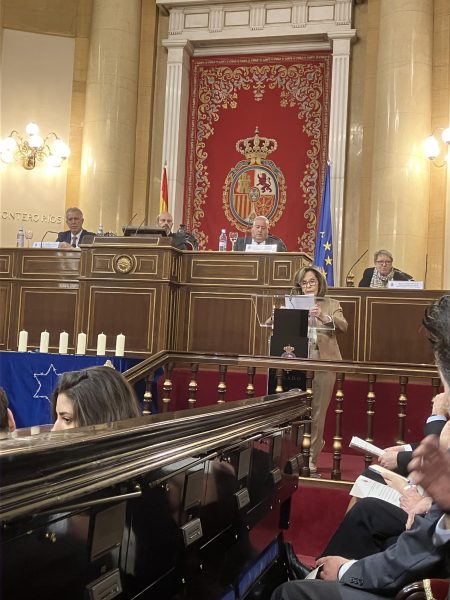

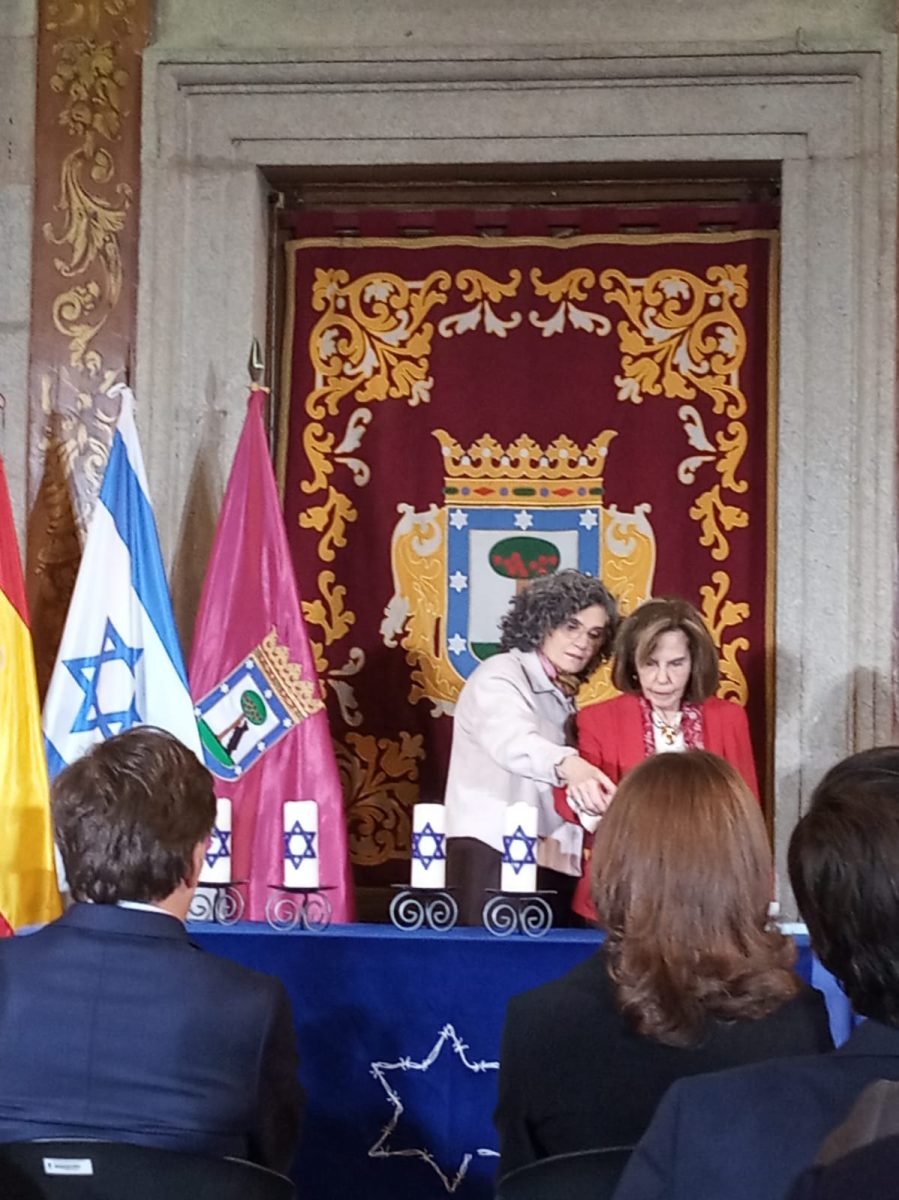
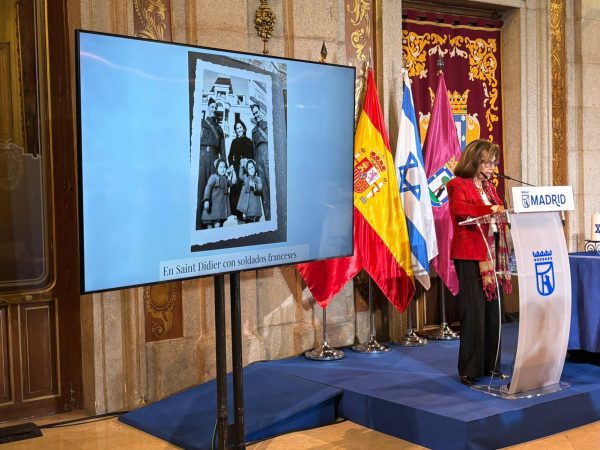
 The mother of GOA Spanish teacher Señora Hassin spoke in Madrid this winter to members of the Spanish Senate and an audience of secondary school students, describing her childhood experiences in Nazi-occupied France and years spent in hiding.
The presence of school groups allowed her to confront young audiences with lived testimony rather than abstract statistics.
“It is fundamentally different from reading a chapter in a history textbook,” Hassin observed. “When students encounter a living witness, the historical event becomes immediate and personal.”
Born in Paris in 1937 to Polish Jewish parents, Denise Berger Kornfeld is the last living Holocaust survivor in Spain. She was two years old when Germany invaded France in 1940.
Her early childhood unfolded against the rapid collapse of French resistance and the extension of Nazi racial laws.
Seeking safety, her family relocated to the south of France. The move offered only partial protection.
“My mother has always said she was fortunate because they escaped,” Hassin said in a recent interview. “But survival does not erase trauma. Crossing mountains, living in hiding for years– those experiences leave a mark.”
Her father was denounced as a Jew and interned in the Le Vernet camp, a detention site used for Jews, political opponents and refugees from Spain. Conditions there were severe, marked by overcrowding, illness and deprivation.
An episode of sickness led to his temporary release on medical grounds, creating an opportunity for escape.
By 1942, as deportations intensified, Berger Kornfeld’s parents made the decision to flee across the Pyrenees Mountains into Spain. Though governed by General Franco’s dictatorship, it remained officially neutral during World War II.
Assisted by a guide familiar with the mountainous terrain, members of the family crossed the border under perilous conditions.
Berger Kornfeld and her twin sister did not immediately accompany their father. They remained in a French village under the protection of local allies, including a school principal who was a family friend and later members of a convent.
For much of the war, they were hidden by a family who monitored Nazi patrol movements and arranged concealment whenever searches were anticipated.
Berger Kornfeld has recalled sleeping with a packed suitcase beside her bed, prepared to flee at a moment’s notice.
After entering Spain, Berger Kornfeld’s father was imprisoned before receiving assistance from the American Jewish Joint Distribution Committee, which facilitated the resettlement of displaced Jews. When the war ended, the family reunited in Spain; Berger Kornfeld was approximately nine years old.
Her father rarely spoke about his experiences, particularly the loss of extended family members who were murdered during the Holocaust.
Instead, the grandparents emphasized narratives of resilience: planting gardens when food was scarce, improvising shoes from car tires when materials were unavailable.
In postwar Spain, the Jewish community was small and largely peripheral. While not subject to systematic persecution, it remained limited in size and visibility.
During the 1950s, North African Jewish communities migrated to Spain in greater numbers, reshaping its Jewish demographic profile.
Today, much of Spain’s Jewish population traces its origins to Morocco and other parts of North Africa, with Ashkenazi families such as Berger Kornfeld’s representing a smaller segment.
Despite rebuilding her life in Barcelona and describing her childhood there as stable and socially fulfilling, Berger Kornfeld acknowledges the enduring psychological dimensions of displacement.
She has publicly maintained that she does not consider herself traumatized, while Señora Hassin offers a more nuanced interpretation.
“There are residual insecurities,” Hassin said. “When you come from a family of exile, there is often an underlying sense that security is fragile.”
Hassin identifies patterns common among survivors and their descendants: small, tightly knit families; heightened vigilance; and an emphasis on protection. In many cases, silence also shaped the postwar household.
“My grandparents did not want to dwell on the past,” she said. “They belonged to a generation that endured quietly.”
Señora Hassin’s mother has expressed regret that she did not ask her own parents more detailed questions while they were alive.
On Hassin’s paternal side, her family history reflects a longer arc of exile and return.
Her father is a descendent of Sephardic Jews expelled from Spain during the Inquisition who resettled in the Ottoman Empire, in present-day Turkey.
There, Jewish communities preserved Ladino, a form of medieval Spanish written in Hebrew characters, and maintained cultural ties to Spain.
Synagogues were named after the Spanish cities from which their ancestors had been expelled.
In the early twentieth century, rising instability prompted Hassin’s paternal grandparents to leave Turkey for Italy.
Spanish legislation allowing descendants of Jews expelled during the Inquisition to reclaim citizenship enabled them to register for Spanish passports in Milan.
That documentation later proved critical. During the Nazi occupation of France, Spanish diplomat Bernardo Rolland y Miota, now recognized at Yad Vashem as one of the Righteous Among the Nations, assisted families holding Spanish passports.
Hassin’s paternal family ultimately relocated to Barcelona, returning to a country from which their ancestors had been expelled centuries earlier.
Raised in Barcelona in close proximity to her grandparents, Señora Hassin reports that her engagement with family history deepened over time. “As I grew older, I felt a stronger sense of responsibility,” she said. “The firsthand witnesses are disappearing. That changes how history will be transmitted.”
That transition was evident in the recent Senate appearance. Berger Kornfeld addressed legislators and students not only to recount her own survival but also to represent those whose voices were extinguished.