
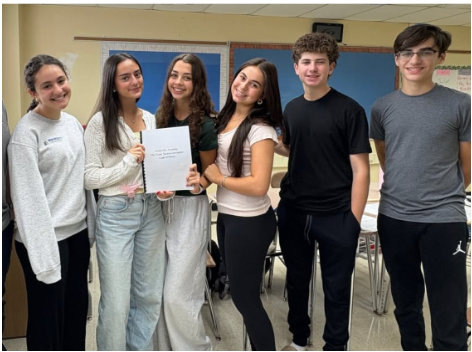
Golda Och Academy’s journalism students announced the creation of a GOA Journalism Code of Ethics last spring. The Code will ensure all Flame articles adhere to ethical journalism practices.
The new code of ethics consists of six sections: Accuracy, Harm Prevention, Responsibility, Respect and Transparency, Integrity and Independence and Editorial Process. These sections are designed to ensure all articles are moral, factual and well-written before being published.
“Our six topics are important for our code of ethics because they provide structure and legible rules and guidelines for staff to follow for the future, in addition to providing a safe space for students to express their ideas,” said journalism student Paul Raskin.
The grade 10 journalism class, taught by The Flame’s advisor, Mr. Langer focused on responsible journalism during the final weeks of its 2025 spring semester. After reading the Society of Professional Journalists (SPJ) Code of Ethics and analyzing professional examples, the students created their own Code of Ethics tailored to GOA’s community.
“I believe that teaching students about responsible journalism is important,” said Mr. Langer. “We want everyone to approach their work with ethics in mind; it’s a core Jewish value.”
This principle reflects GOA’s broader mission to develop students who lead with integrity and use their voices thoughtfully.
He also pointed out the importance of this responsibility within the school community. “Personally, as advisor of The Flame, I care about making sure students write responsibly, as our publication represents our school,” explained Mr. Langer.
“Since students consume so much media, it’s important to be able to recognize when journalism is responsible or irresponsible,” he said. With the constant flow of information online, Mr. Langer believes students need the tools to question sources, detect bias and understand the difference between opinion and fact.
While the SPJ code outlines general principles like “Seek Truth and Report It” and “Minimize Harm”, The Flame’s version discusses school-specific guidelines. These include respecting students’ privacy, avoiding AI-generated content and ensuring that all article topics are pre-approved by Section Editors and the Editor-in-Chief.
The Flame is committed to ensuring all content is original and well-written without the help of any artificial intelligence; the new Code of Ethics focuses on achieving this goal.
GOA Language Arts Department Chair, Mr. Hefetz said, “I believe if you are caught using Artificial Intelligence in any capacity, you need to be fired immediately from The Flame. There is absolutely no room for any use of AI for The Flame.
“Even though The Flame is a school newspaper, we must create a microcosm of what real journalism is. Articles should be human-created, human-sourced and human-edited,” he said.
The journalism class also studied examples of irresponsible journalism in national publications, such as The New York Times, USA Today, The Wall Street Journal and The New York Post, which helped students identify red flags, including bias, inflammatory language and factual inaccuracy.
Journalism student Alma Adiel said, “While I was investigating irresponsible journalism, I came across many instances of bias in articles. These articles depicted a situation from one specific perspective without the same detail from the other side. Opinion phrases like ‘finally’ or ‘unfortunately,’ and subjective adjectives like ‘misguided’ or ‘important’ showed clear bias.”
To combat this issue, The Flame emphasizes a commitment to balanced reporting, ensuring a safe environment where students feel valued and seen.
“The Flame places a firm priority on representing all perspectives,” Alma added. “The Code of Ethics we created ensures that our publication reflects the diversity of thought within our school.”
The Code also seeks to empower newer writers and editors with clear expectations. By establishing shared and transparent standards, students in the journalism class aim to prevent confusion and inconsistency.
Mr. Langer said, “To have something actually codified and written and solidified, I think it can only help new students as they come on and give them guidance.”
This approach was strongly supported by the former leadership of The Flame, who experienced the challenges of managing without a written code.
Former Flame Co-Editor-in-Chief Henry Sacks explained, “Ensuring that articles are written with a strong moral compass and that writers exemplify empathy and honesty are critical to producing a strong newspaper. If there was a Code of Ethics in place when I was Editor-in-Chief, I would’ve had an easier time making decisions in a leadership position.”
To enforce these ethical guidelines, The Flame will undergo a three-tier editing process, progressing from writer to section editor, then to Editor-in-Chief, with oversight from the faculty advisor. Any violations of the code will be addressed with feedback, revision requirements and, when necessary, removal of the article before publication.
While GOA now has a formal, student-created code, some nearby schools do not have an official, written code of ethics for student journalism.
Izzy Suelto, an editor for The Mountaineer, Montclair High School’s student newspaper, explained, “We have rules to follow, but not a specific document we can refer back to. It’s more of an unwritten system—something you learn through experience.”
While other schools operate with unspoken expectations, GOA’s codified approach provides students with a concrete foundation, making it easier to uphold shared standards.
In addition to ethical principles, the students also studied the legal foundations of student journalism. They explored the First Amendment, which guarantees freedom of the press, and relevant court cases such as Tinker v. Des Moines and Hazelwood v. Kuhlmeier.
In Tinker, the court ruled that students do not “shed their constitutional rights to freedom of speech or expression at the schoolhouse gate.” However, in Hazelwood, the court allowed school administrators more control over school-sponsored student publications.
GOA students are especially impacted by New Jersey’s “New Voices” law, which gives student journalists the right to publish freely without interference from school administrators.
“Knowing that student journalists are legally protected to report the truth made me realize I have to use that power responsibly,” said junior Mia Eskin.
As the GOA Journalism Code of Ethics officially takes this school year, the students behind it hope to create a lasting impact on the school, effectively enforcing responsible journalism and maintaining GOA and Jewish values.
The Code reflects Jewish principles such as emet (truth), kavod (respect) and achrayut (responsibility). By following these principles, The Flame staff is not only promoting ethical journalism but also honoring the moral foundation of the GOA community.